What Is Rapid Impact Compaction?
Rapid impact compaction is a repeated impact densification method that uses a hydraulic hammer and compaction plate to improve fill density more deeply than conventional rolling compaction.

Complete range of 14 rapid impact compaction machine models covering 4kJ to 300kJ impact energy for bridge abutments, embankments, confined zones, and general ground improvement projects.
This page introduces the HC Series product range, typical applications, effective depth, and model selection logic for common ground improvement projects.
Rapid impact compaction (RIC) is a ground improvement method that uses a hydraulic lifting and drop-hammer system to deliver repeated high-energy impacts through a compaction plate. Compared with conventional rolling compaction, RIC transfers energy deeper into the fill, making it suitable for bridge abutments, embankments, backfill zones, industrial foundations, road widening transitions, and other projects where deeper densification and controlled treatment are required.
The HC Series from Taian Hengda Machinery covers 14 models from HC04 to HC300, with effective depth ranges from about 0.4 m to 9 m, depending on soil type, energy level, carrier class, and blow count. Available configurations include loader mounted and excavator mounted solutions. Typical applications include bridge approach compaction, culvert side backfill, high embankment densification, confined-area treatment, and general ground improvement for roads, railways, ports, airports, and industrial sites.
The Rapid Impact Compactor (RIC) drop weights are available in 3.5 t, 5 t, 7 t, 9 t, 10 t, 12 t, 14 t, 16 t, and 20 t, with an effective compaction depth ranging from 1.2 m to 9 m.
Rapid impact compaction is a repeated impact densification method that uses a hydraulic hammer and compaction plate to improve fill density more deeply than conventional rolling compaction.
Typical effective depth ranges from 0.4 m to 9 m. Actual results depend on soil type, moisture content, impact energy, plate size, and the number of blows per point.
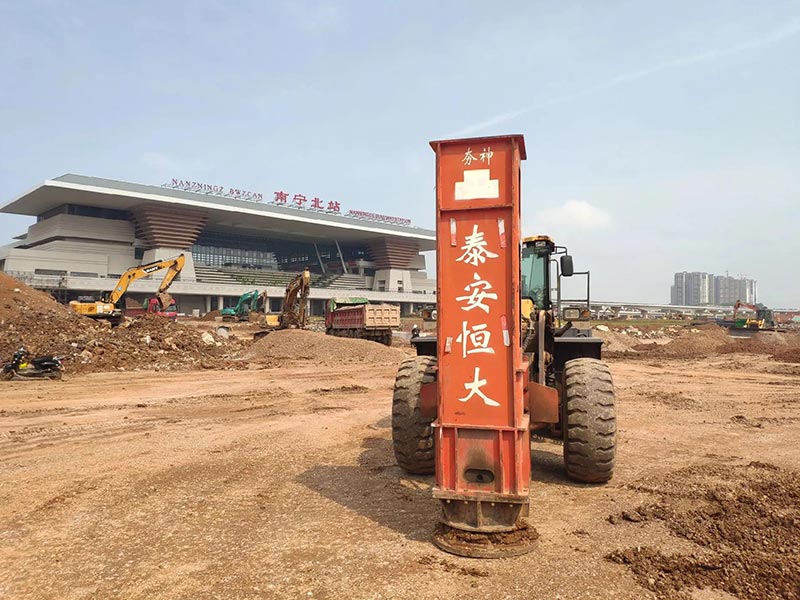
Light Duty | Loader Mounted
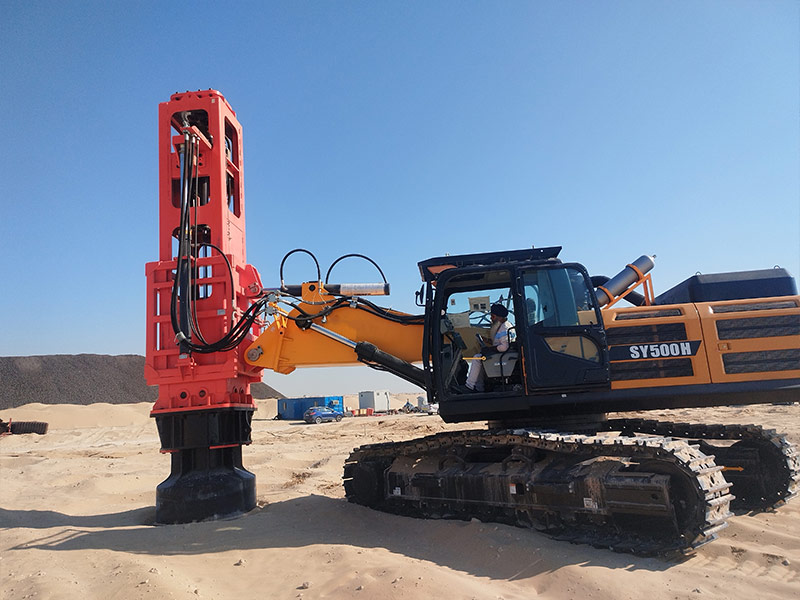
Medium Duty | 45-55t Excavator

Heavy Duty | 70t Excavator
14 models available for different project requirements
| Model | Impact Energy (kJ) |
Drop Weight (kg) |
Depth (m) |
Weight (t) |
Plate (mm) |
Height (mm) |
Pressure (MPa) |
Flow (L/min) |
Compatible Excavator |
|---|---|---|---|---|---|---|---|---|---|
| HC300 | 300 | 20,000 | 5-9 | 34.5 | 2,000 | 8,218 | 31.5 | ~600 | ≥70t (CAT 395F, Volvo EC750, Liebherr R976) |
| HC240 | 240 | 16,000 | 5-9 | 28.9 | 2,000 | 7,613 | 31.5 | ~600 | ≥70t (CAT 395F, Volvo EC750, Liebherr R976) |
| HC210 | 210 | 14,000 | 4-8 | 26.2 | 1,500 | 7,135 | 31.5 | ~600 | ≥60t (CAT 374, XCMG XE650GK, Sany SY650H) |
| HC180 | 180 | 12,000 | 4-8 | 23.8 | 1,500 | 6,838 | 31.5 | ~600 | ≥60t (CAT 374, XCMG XE650GK, Sany SY650H) |
| HC150 | 150 | 10,000 | 4-8 | 21.5 | 1,500 | 6,533 | 31.5 | ~500 | 45-55t (SUMITOMO SH490, VOLVO EC480, CAT 349) |
| HC108 | 108 | 9,000 | 2.5-6.5 | 20.1 | 1,500 | 6,450 | 25 | ~350 | 40-45t (CAT345, XCMG XE450) |
| HC84 | 84 | 7,000 | 2.5-6.5 | 13.5 | 1,250 | 5,100 | 25 | ~350 | 40-45t (CAT345, XCMG XE450) |
| HC60 | 60 | 5,000 | 2.5-6.5 | 10.8 | 1,250 | 4,660 | 25 | ~350 | 35-40t Excavator / Loader |
| HC42 | 42 | 3,500 | 1.2-2.5 | 6.3 | 1,000 | 3,730 | 16 | ~160 | 30t Excavator / 5t Loader |
| HC36 | 36 | 3,000 | 1.2-2.5 | 5.8 | 1,000 | 3,730 | 16 | ~160 | 30t Excavator / 5t Loader |
| HC16 | 16 | 1,600 | 0.8-1.5 | 3.1 | 630 | 3,230 | 12 | ~130 | 15-25t Excavator / Loader |
| HC12 | 12 | 1,200 | 0.8-1.5 | 2.3 | 630 | 3,230 | 12 | ~130 | 15-25t Excavator / Loader |
| HC08 | 8 | 800 | 0.4-1 | 1.7 | 560 | 2,450 | 5 | ~100 | 7-13t Excavator / Loader |
| HC04 | 4 | 400 | 0.4-1 | 1.3 | 560 | 2,450 | 5 | ~100 | 7-13t Excavator / Loader |
Note: Parameters are standard design values. For special requirements, please contact us for customization.
The section below connects applications, effective depth, and model choice so engineers and buyers can compare the HC Series more efficiently.
The HC Series product family supports a wide range of ground improvement equipment needs, including bridge approach compaction, embankment reinforcement, backfill densification, and confined-area treatment. This guide connects specification data with practical engineering scenarios, making it easier to compare models by working depth, carrier class, and site conditions.
| Comparison Point | Rapid Impact Compaction (RIC) | Dynamic Compaction (DC) |
|---|---|---|
| Energy Delivery | Repeated hydraulic impacts through a compaction plate. | High-energy free-fall impacts from a crane-dropped tamper. |
| Mobility | Mounted on loader or excavator, easier to move between points and linear jobsites. | Requires crane-based setup and more open operating area. |
| Typical Work Area | Bridge abutments, embankments, culvert backfill, confined or narrow infrastructure zones. | Large open sites with fewer geometric restrictions. |
| Control Near Structures | Better suited for controlled work near sensitive structures or transition sections. | Usually less flexible near structures because of larger impact events and open-area requirements. |
| Deployment Logic | Good for projects that need model choice by carrier class, depth, and jobsite access. | Good for broad-area treatment where crane access and drop height are available. |
| Typical Buyer Question | Which HC model fits my target depth and carrier machine? | Do I have enough open space and crane capacity for dynamic compaction? |
Note: The best method depends on soil type, access conditions, treatment depth, nearby structures, and required production rhythm.
Common questions covering model selection, effective depth, soil considerations, and buying guidance.
Rapid impact compaction is a hydraulic impact densification method that repeatedly drops a hammer onto a compaction plate to improve the density and bearing capacity of fill materials more deeply than standard rolling compaction.
Start with the target effective depth and available carrier class. After that, compare impact energy, hydraulic pressure, flow rate, and whether the project is in a bridge, embankment, confined, or open-area environment.
Yes, our prices are based on FCA Qingdao Port, China.
The hammer, hydraulic cylinder, and some components are sourced from our qualified suppliers, while the frame and boom are designed and manufactured in-house.
Typical HC Series effective depth ranges from about 0.4 m to 9 m. The actual treatment depth depends on soil type, moisture, impact energy, hammer weight, plate size, and the number of blows applied at each point.
RIC is commonly used on engineered fills, embankments, roadbeds, bridge backfill, industrial pads, and general ground improvement. Performance varies according to soil gradation, moisture, and structural sensitivity nearby.
All products are self-manufactured by our company and we can provide full intellectual property rights.
For one unit, shipment to the designated port in China will be arranged within 30 working days after receipt of the advance payment. For multiple units, the delivery schedule will depend on the confirmed quantity and models.
Send your target depth, soil condition, and carrier class. Our engineering team can recommend a suitable RIC model and prepare a quotation.